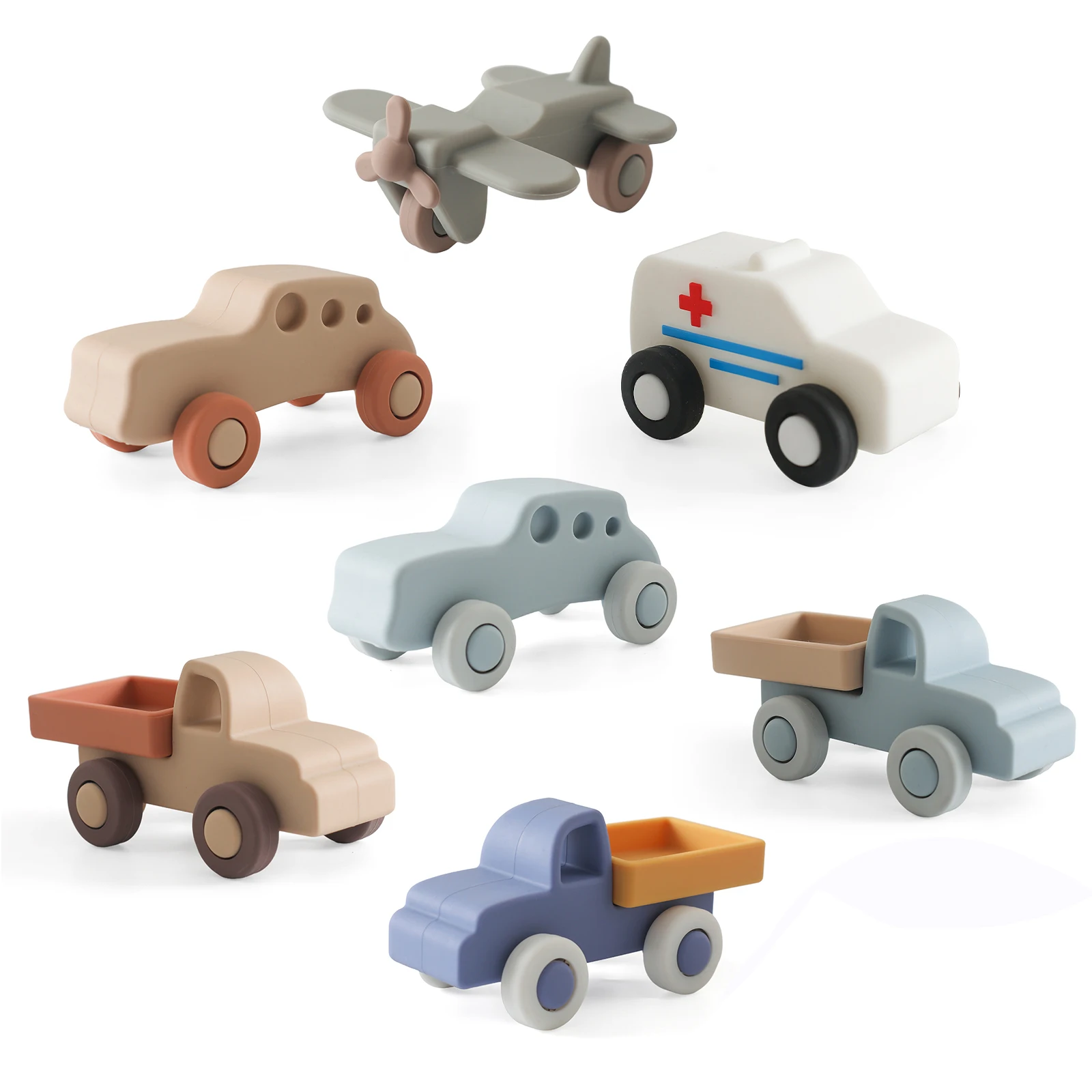

A two-year-old toddler crouches low on the living room floor, pushing a small car forward while tilting their head sideways to watch the spinning motion. As the toy glides across the rug, the room fills with an enthusiastic, high-pitched vocalization: “Vroom, vroom! Beep, beep!”
“The toy they’re pushing? It’s the silicone vehicle toy baby that doubles as a teether.”
To a busy parent, this looks like a standard, quiet afternoon activity. However, beneath this simple play sequence lies a profound milestone of cognitive architecture.
Your child is demonstrating their very first use of onomatopoeic language, experimenting with early symbolic representation, and exploring the fundamental physics of motion and momentum.
The drive to track, slide, and chase rolling objects is an innate human milestone. Yet, conventional toy cars are often poorly suited for the realities of early infancy, presenting major structural hazards when small children do what they do best: put everything into their mouths.
I am Elara Voss — Child Development Specialist & Infant Wellness Researcher. My daily focus centers on studying the intersection of early childhood motor milestones and industrial product engineering.
Today, we are taking an in-depth, evidence-based look at the Little Driver Silicone Vehicle Toy Baby collection. Does this flexible, racer-shaped baby teething toy car truly serve as an effective developmental tool, or is it merely another cute accessory for the toy box? Let’s analyze the developmental neuroscience of vehicle-based play.
The “Vroom” Phenomenon: Why Babies Are Obsessed With Vehicles
The intense fascination that infants and toddlers display for cars, trucks, and trains is a universal childhood pattern. This specific play preference cuts cleanly across diverse cultural landscapes, genders, and generations. Whether a child is raised in a bustling urban center or a remote, pre-industrial community, their eyes will naturally lock onto objects that roll, glide, and spin.
This universal obsession is rooted deep within our evolutionary biology rather than being a product of modern advertising. Pioneering research led by cognitive psychologist Dr. Elizabeth Spelke (2007) on object cognition demonstrates that human infants possess an innate “core knowledge” system specifically tuned to tracking moving objects.
From birth, a baby’s visual system is highly responsive to path trajectories, changes in speed, and spatial transitions. Vehicles activate this innate cognitive network more effectively than almost any other category of toy.
Throughout human history, long before the invention of the modern automobile, children in ancient cultures crafted wheeled clay animals and small wooden carts to drag through the dust. The biological drive to interact with moving objects is part of how the infant brain decodes the rules of the physical world.
“The solution is a one-piece silicone vehicle toy baby like Little Driver.”
The Hidden Danger of Traditional Toy Cars
While the developmental benefits of vehicle play are clear, traditional toy cars manufactured from rigid plastics, die-cast metal, or treated wood introduce substantial safety issues into a nursery environment.
1. Paint Toxicity and Surface Erosion
Traditional wooden and hard plastic toy cars are frequently finished with bright surface paints, glossy lacquers, or clear chemical varnishes to make them visually appealing. However, when an infant mouths these items, their acidic saliva breaks down these coatings.
Over time, the paint chips and peels, presenting a real risk of chemical ingestion. The toy industry has a long history of major safety recalls due to lead or cadmium contamination in surface paints on popular die-cast and plastic vehicles, highlighting the need for safer alternatives.
2. Sharp Edges from Impact Shattering
Rigid polystyrene and cheap molded plastics possess very poor impact resistance. When a toddler inevitably hurls a plastic car against a brick wall or drops it onto a tile floor, the structural shell can easily fracture or split. This damage leaves behind razor-sharp edges and pointed shards that can easily slice open soft fingers, lips, or gums during play.
3. Serious Choking Risks from Detachable Parts
Standard toy cars are multi-piece assemblies. They rely on small metal axles, rubber tires that slide off the wheels, plastic hubcaps, and glued-on details like side mirrors or radio antennas.
Under the intense chewing force of a teething baby, these components can easily snap or pull loose. These detached pieces instantly turn into major choking hazards inside a child’s airway. Shifting to a single-piece, molded soft silicone toy cars toddler layout elegantly eliminates all three of these structural liabilities simultaneously.
The Neuroscience of Vehicle Play
When an infant aligns their hand over a montessori car toy baby and pushes it forward, they are initiating an intensive neural workout that stimulates multiple areas of the brain at once.

Cause & Effect Mastery
When your baby applies force to the car, it rolls forward; when they stop pushing, it slows down. This straightforward action creates their very first physical “if…then” logical deduction.
This loop exercises the prefrontal cortex—the command center for logical reasoning, planning, and analytical thinking—helping them realize that their actions have a direct, predictable impact on the objects around them.
Object Permanence Tracking
Between 8 and 12 months of age, infants are actively developing their understanding of object permanence—the cognitive awareness that an object continues to exist even when it rolls out of direct sight.
When the Little Driver rolls behind a couch cushion or under a low table, the baby must hold a mental image of the vehicle in their working memory, motivating them to crawl forward, lift the obstacle, and retrieve it.
Spatial Reasoning and Trajectory Physics
Maneuvering a rolling vehicle around furniture legs, over play mats, and down inclines acts as an intuitive, three-dimensional geometry lesson.
Your toddler must continuously calculate spatial distances, predict paths of movement, and adjust their physical push force to avoid collisions. This early spatial play builds foundational skills for future abstract math and engineering literacy.
Phonological Awareness and Early Speech
The sensory feedback of vehicle play is an outstanding catalyst for speech development. The classic vocalizations associated with cars—like “vroom,” “zoom,” and “beep”—are simple onomatopoeias composed of basic phonemes.
Pediatric speech-language pathologists frequently observe that children produce a wider range of communicative sounds while playing with moving vehicles than when interacting with static toys, making these toys an excellent tool for early language acquisition.
👉 Shop the Little Driver Collection Now
👉 Explore Our Full Montessori Collection
Anatomy of the Little Driver Collection
“Let’s examine what makes this silicone vehicle toy baby collection unique.”
The Little Driver collection is a beautifully executed piece of functional infant engineering. Let us break down its core structural design choices:
Premium 100% Food-Grade Silicone Body
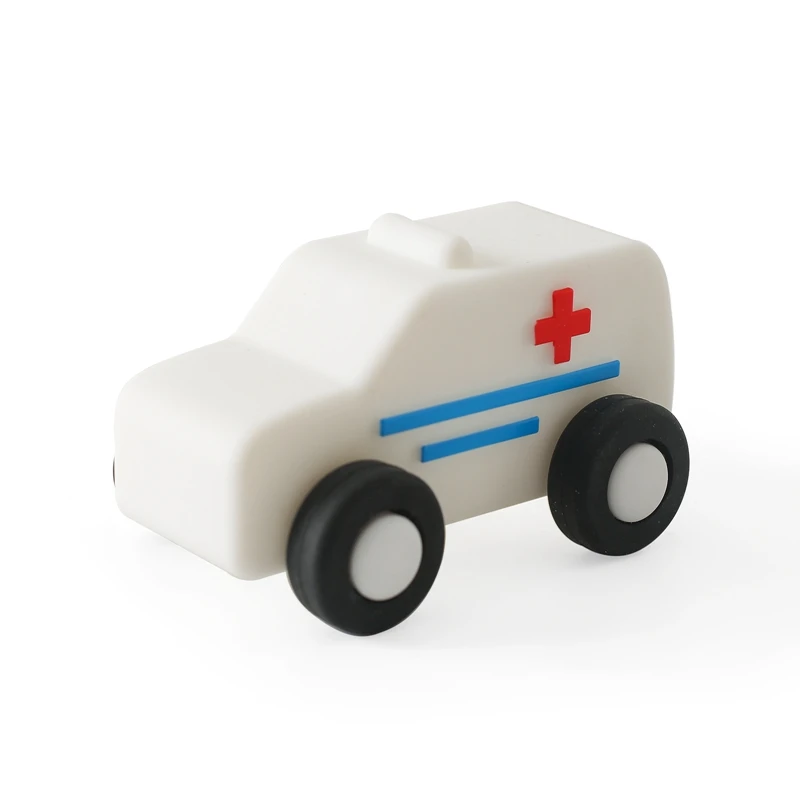
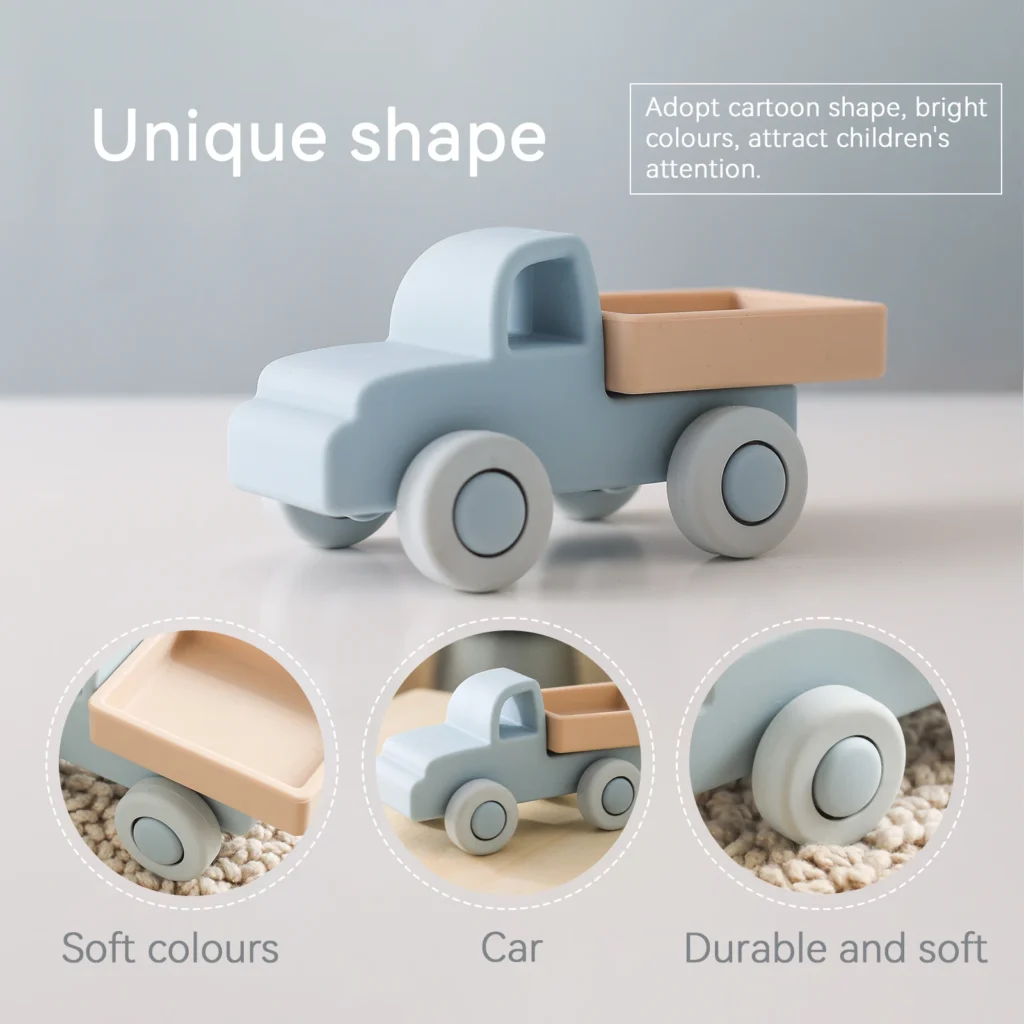
Leaving behind brittle plastics and toxic varnishes, the Little Driver is molded entirely from high-density, food-grade silicone. The material is chemically pure, hypoallergenic, and completely free from BPA, phthalates, and heavy metals. It features a unique structural resilience—it acts as a soft, safe shock-absorber that handles high-impact drops silently while offering a completely safe chewing surface.
360° Multi-Textured Sensory Surfaces
The exterior design of each vehicle is intentionally sculpted to maximize tactile stimulation. The car features ribbed body lines, deeply grooved tire treads, and smooth central zones. This varied architecture delivers rich sensory input to both exploring fingers and tender dental arches, serving as an exceptional teething aid that delivers therapeutic counter-pressure to sore, swollen gums.
Ergonomic Push-Grip Geometry
The central cabin area of each vehicle features a wide, hollowed-out opening designed precisely around infant hand dimensions. At 3 months old, a baby can easily loop their fingers through the opening using their early palmar grasp. As they grow into toddlers, this same opening transforms into a comfortable handle for advanced push-and-steer imaginative play.
👉 Shop the Little Driver Collection Now
👉 Explore Our Full Montessori Collection
Single vs. 7-Piece Set : Which Is Right for Your Baby?
The Little Driver collection is offered in two distinct configurations tailored to different developmental stages and family budgets:
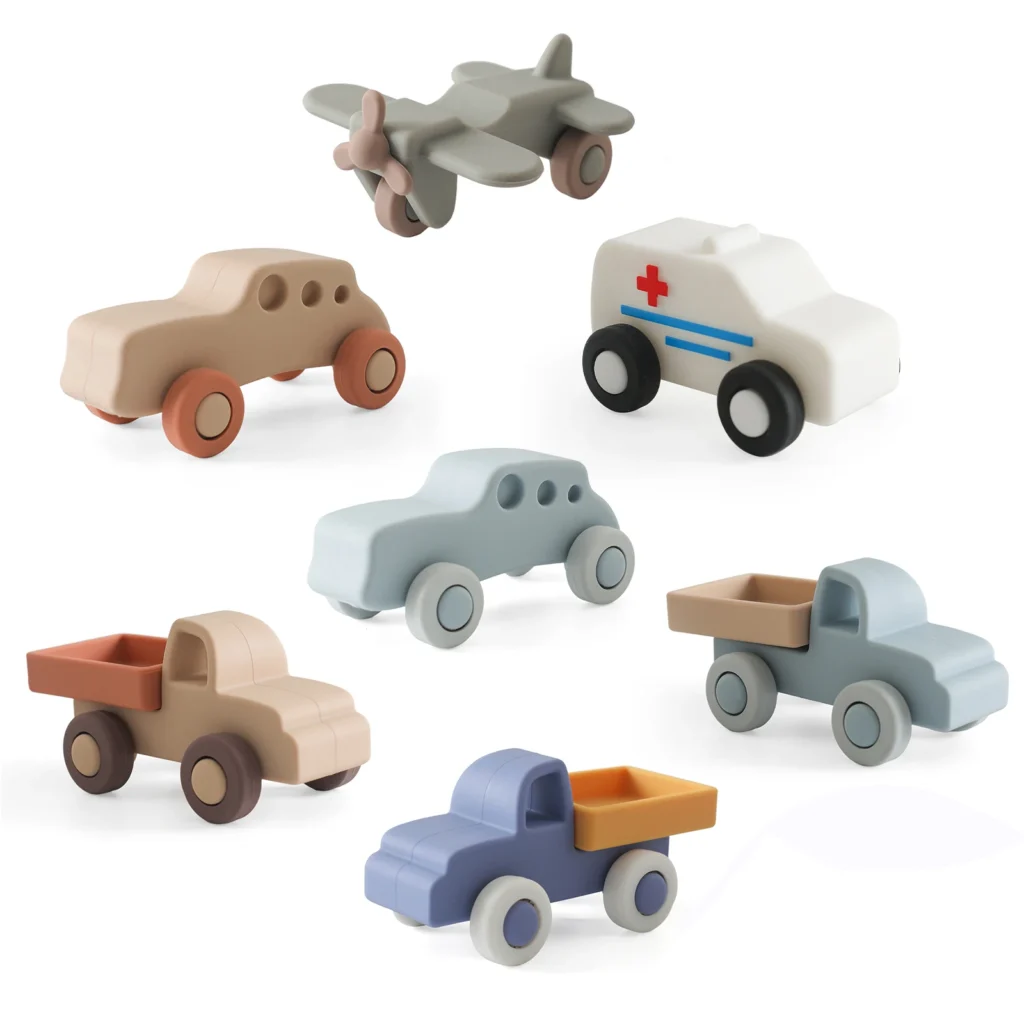
The Single Vehicle Configuration
This targeted option is perfect for early infancy (3 to 6 months). At this stage, your baby’s primary needs are sensory oral soothing and early grasping practice. The single vehicle fits easily into diaper bags, making it an affordable, travel-friendly option and an ideal token gift for a baby shower or newborn celebration.
The Collector 7-Piece Set
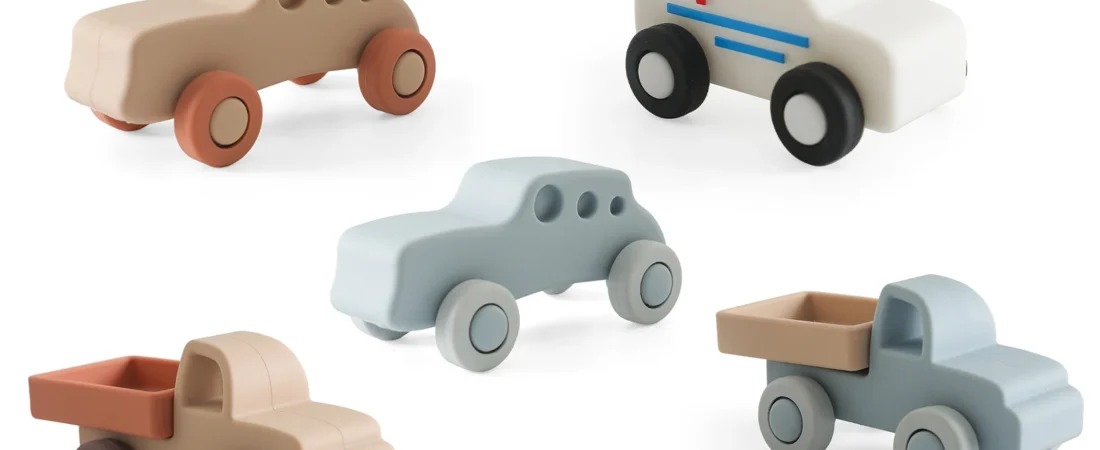
Designed for older infants and toddlers (6 months to 3 years), this comprehensive set unlocks the full educational power of the collection. It includes a beautiful spectrum of vehicle archetypes—such as race cars, trucks, and family vehicles—molded in a sophisticated palette of soft, Montessori-friendly tones. This variety allows parents to create complex learning environments based on sorting, counting, and creative storytelling.
Selection Matrix
| Family Requirement | Single Vehicle Option | 7-Piece Collector Set |
|---|---|---|
| Ideal Target Age | 3 to 6 Months | 6 Months to 3 Years+ |
| Primary Play Focus | Early teething relief & grasping practice. | Montessori sorting, counting, & role-play. |
| Developmental Benefit | Strengthens basic hand-eye coordination. | Exercises advanced sequencing & vocabulary. |
| Gifting Impact | Low-cost, practical token gift. | Premium, long-lasting milestone present. |
“Whether you choose one or seven, every silicone vehicle toy baby is BPA-free.”
5 Years of Play: The Little Driver Growth Map
A truly exceptional open-ended toy adapts beautifully to your child’s changing milestones. The Little Driver collection offers an impressive multi-year lifespan:
3 Months+: Grasping & Visual Tracking
In early infancy, the vehicle works as an elegant sensory teether. Your baby practices holding the ergonomic cabin handle and guiding the textured wheels to their mouth to soothe teething pain. Parents can roll the car across the blanket to practice smooth visual tracking.
6 Months+: Object Permanence & Crawling Motivation
As your baby masters sitting and begins to scoot, they love to push the car forward and watch it glide away. Tracking the car as it rolls encourages them to lunge forward and crawl after it, building their gross motor coordination and core strength.
12 Months+: Direct Chasing Games
By their first birthday, toddlers love active, high-energy play. They will enthusiastically roll the Little Driver across hardwood floors, chasing after the vehicle with speed, which helps refine their standing balance and walking mechanics.
18 Months+: Montessori Sorting & Logic
This is the stage where analytical thinking blossoms. Using the 7-piece set, toddlers will begin sorting the vehicles by their unique shapes, aligning them by size graduations, and grouping them by color tones, seamlessly blending math concepts into playtime.
2 to 3 Years: Narrative Role-Play
The abstract silicone shapes now transform into the characters of complex stories. Your toddler will build cardboard ramps, map out imaginary city streets across the living room rug, and drive their vehicles through creative adventures, building sophisticated social communication skills.
The Montessori Vehicle Curriculum
In a progressive Montessori educational space, toys are valued for their realism, simplicity, and ability to encourage self-directed learning. The Little Driver 7-piece set functions as an excellent Montessori learning material through several hands-on activities:

- Color & Shape Sorting: Parents can arrange colored mats on the floor and encourage the child to match each vehicle to its corresponding base color. This exercises visual discrimination without artificial electronic corrections.
- Size Sequencing: Children can practice lining the vehicles up from the shortest to the longest, building early physical concepts of measurement and serial order.
- The Physics Incline: Set up a simple wooden board at varying angles. Let your child release the silicone vehicles from the top, observing how changing the steepness of the ramp alters the car’s speed and travel distance. This provides an intuitive, hands-on physics lesson that honors Maria Montessori’s belief that movement and hands-on manipulation are central to building cognitive intellect.
Bath Time Racing — The Bonus Feature
A brilliant hidden benefit of high-purity silicone engineering is its absolute resistance to water damage. Traditional toy cars with metal axles or wooden components will quickly rust, warp, or rot if exposed to water. The Little Driver collection, however, is entirely waterproof and non-porous.
This material stability allows you to bring the entire fleet straight into the bathtub, turning bath time into a fun water-racing game. For toddlers who experience transitions or bath anxiety, these familiar cars serve as a comforting distraction. They scoop water, float beautifully, and can be easily dried, completely preventing the internal mold growth that common hollow plastic bath toys trap.
“Even in the bath, this silicone vehicle toy baby stays safe and mold-free.”

“Unlike plastic cars, this silicone vehicle toy baby won’t grow mold.”
Safety & Certifications
When you place a toy into your child’s hand, safety credentials must be perfectly transparent and verified to global baselines.
| Safety Baseline Metric | Certification Verified | Direct Parent Benefit |
|---|---|---|
| Material Base Purity | 100% Food-Grade Silicone | Zero chemical migration; entirely safe to mouth. |
| Chemical Screen | BPA, Phthalate, & Lead-Free | Total protection for the developing endocrine system. |
| Mechanical Security | Monobloc Solid Mold (One-Piece) | Zero Choking Hazard. No wheels or axles can snap off. |
| Surface Finish | Dye-Infused Base Polymer | No paints, lacquers, or varnishes to chip or flake. |
| Thermal Range | Dishwasher, Boiler, & Fridge Safe | Allows for effortless sterilization and cooling therapy. |
How Little Driver Compares to Alternative Toy Cars
| Vehicle Toy Type | Safety Profile | Teether Safe | Choke Hazard Risk | Washability | Montessori Aligned |
|---|---|---|---|---|---|
| Little Driver Silicone | Maximum | Yes (Soft) | Zero (Monobloc) | Dishwasher Safe | Excellent |
| Cheap Rigid Plastic | Low (Sharp shards) | No | High (Snap-off wheels) | Hand wash only | Poor (Cartoonish) |
| Traditional Wood | Medium (Splinters) | No | Medium (Glued parts) | Surface wipe only | Good (Natural) |
| Die-Cast Metal | Low (Heavy/Hard) | No | High (Small screws) | Risk of rust | Moderate (Weight) |
Play Scenarios Elara Loves
To unlock the full potential of your silicone vehicle toy baby collection, try introducing these five practical play setups in your home today:
- The Trajectory Race: Sit on the rug opposite your infant (3-6M) and slowly roll a single vehicle across their field of vision. This simple tracking game strengthens ocular muscles and develops visual focus.
- The Blanket Tunnel: Drape a small receiving blanket over your forearm to create a low tunnel on the floor. Guide the Little Driver through the opening, hiding and revealing the car to play a fun game of object permanence peek-a-boo.
- The Categorization Lane: Draw simple chalk or tape lines on a play mat to create distinct parking zones. Encourage your toddler to sort and park the cars by color or vehicle type.
- The High-Seas Fleet: Bring the 7-piece set into the bath. Let your child float the cars along the water surface and use them as pouring cups to rinse away soap, turning hygiene into an engaging sensory game.
- The Cooling Track Prep: On warm summer afternoons or during an intense teething wave, place the Little Driver in the refrigerator for twenty minutes. The cool, dense silicone wheels provide refreshing cryotherapeutic massage directly to hot, swollen gums as your baby chews.
FAQ: Expert Answers to Parent Questions
1. What is the precise age recommendation for the Little Driver collection?
The collection is safety-graded and structurally certified for infants starting at 3 months old up to toddlers at 3 years of age and beyond, gracefully moving from a teether to a sophisticated role-play car.
“Q: Is this silicone vehicle toy baby safe for newborns? A: Yes, from 3 months.”
*”This silicone vehicle toy baby is safety-certified from 3 months.”*
2. Is it genuinely safe for my baby to chew intensively on the wheels?
Yes, absolutely. Because each vehicle features a solid, one-piece molded construction from premium food-grade silicone, there are no separate tires, axles, or tiny screws that could snap off, making it completely safe for teething.
3. Should I invest in a single car or purchase the full 7-piece set?
For young infants (3-6M) focusing on teething relief, a single vehicle is an excellent starting point. For toddlers (6M+) ready for Montessori sorting, counting, and imaginative play, the 7-piece set offers significantly more long-term value.
4. Can these cars be submerged in bathwater without growing internal mold?
Yes. Unlike hollow plastic toys that trap stagnant water inside, the Little Driver is a solid, non-porous silicone structure with zero internal cavities, making it completely mold-resistant and easy to dry.
5. Are these vehicle toys appropriate gifts for both baby boys and baby girls?
Absolutely. Exploring tracking physics, trajectory lines, and spatial logic is a universal milestone for every human infant, making this neutral-toned collection an inclusive gift for all young explorers.
Whispers from the Ages — 4,500 Years of Wheeled Play

The joy a child feels when pushing a miniature vehicle across a flat surface connects us directly to the history of human play.
⚠️ AGELESS CAUTION: These practices come from traditions, often thousands of years old. They have not been validated by modern controlled scientific studies. They may carry risks of allergy, choking, toxicity, or simple ineffectiveness. They do not replace medical advice or proven treatment. Use at your own responsibility, and only after speaking with your child’s health professional.
When archeologists excavate the ancient settlements of the Indus Valley Civilization (dating back to 2500 BC), they consistently uncover beautifully detailed toy clay carts featuring fully functional, spinning wheels inside children’s burial sites at Mohenjo-daro.
In the tombs of ancient Egypt, researchers have uncovered small wheeled animals carved from natural sycamore wood. In early Rome, children played with detailed, miniature bronze chariots, while in ancient Greece, young minds dragged clay horses mounted on tiny wooden wheels through the streets.
For over 4,500 years, the universal sound of a child mimicking motion has filled homes across every great civilization.
The Little Driver Silicone Vehicle Toy Baby collection represents the modern evolution of this shared human heritage—taking a classic play concept and upgrading the medium to high-purity, indestructible food-grade silicone for absolute safety in the modern home.
The Verdict: A Structural Triumph for Mind and Body
The Little Driver Silicone Vehicle Toy Baby collection is a beautiful example of thoughtful product engineering. By replacing rigid plastics, heavy metals, and toxic surface paints with a solid, seamless food-grade silicone structure, it delivers a deeply satisfying play experience.
It completely protects your little one from sharp broken shards, paint flakes, and choking risks, while actively supporting their fine motor coordination, cause-and-effect understanding, and early language development. For parents seeking an engaging, open-ended toy that spans the transition from intensive teething to imaginative storytelling, the Little Driver collection is an outstanding investment.
Complete your Montessori collection with our Pastel Dreams Silicone Rainbow Stacker — the open-ended toy that grows from 6M to 5Y.
Also perfect for sensory play: Soft Building Blocks Silicone Fruit Stacking Set — 7-piece Montessori stacking toy for babies 6M+.
Read our complete guide: Understanding Teething in Babies — Complete 2026 Encyclopedia
Sources & References
- AAP — The Power of Play, 2018
- UNICEF — Learning Through Play, 2018
- American Montessori Society — The Prepared Environment
- Lillard et al. — The Impact of Pretend Play, 2013
- NAEYC — The Role of Play, 2018
- “For a silicone vehicle toy baby that grows with your child, Little Driver is unbeatable.”
“Choose a silicone vehicle toy baby that prioritizes safety and development.”
“Every silicone vehicle toy baby in the Little Driver fleet is dishwasher safe.”
👉 Shop the Little Driver Collection Now
👉 Explore Our Full Montessori Collection